
About the Author Part 1
Welcome to all my relatives, in-laws, friends, and anyone who may have ever wondered who I really am, what my life has been about, and how I have come to see both myself and the world around me.
In these writings, I want to focus primarily on the experiences and struggles that shaped me spiritually and emotionally — especially those connected to religion, faith, fear, truth, and the search for deeper understanding.
Much of what I write about affected me very deeply throughout my life, and I suspect many others may have experienced some of the same inner questions, conflicts, fears, and struggles in their own journey as well.
The Bottomless Pit!
Growing up in a Christian family, I was exposed from an early age to the fundamental teachings and beliefs of Christianity — much like countless other children raised within the church.
But somewhere around the age of seven, those teachings began to affect me in a very deep and personal way.
I remember sitting in church with my parents, listening to sermons from the pulpit at an age when a child is still emotionally tender, impressionable, and extremely sensitive to fear. Concepts that adults may have accepted without question began settling heavily on my mind.
I was only around seven years old when it happened.
The fear of “going to Hell” entered my consciousness
As a child, sermons about “fire and brimstone” and the “bottomless pit,” delivered passionately by a 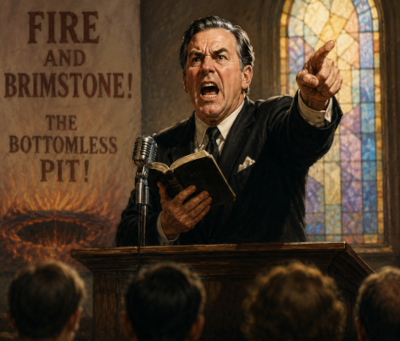 fiery preacher, affected me deeply. I was only a little boy, yet in my imagination I felt myself somehow caught up in the terrifying fate of those believed to be destined for that dreadful “bottomless pit.”
Being a little child and understanding almost nothing about the realities of this world — much less the next one — filled me with fear and anxiety. Combined with the constant fire-and-brimstone sermons, it gradually pushed me into a deeply withdrawn emotional state.

I remember sleepless nights and terrifying nightmares of endlessly falling into a bottomless pit, suffering forever with no hope of escape. To an adult, these may sound like abstract religious concepts. But to a sensitive and frightened second grader, they felt painfully real.
What made it even harder was the feeling that no one truly understood what was happening inside my mind, or how deeply these fears were affecting me.
A Kind Man — Jesus
Then one day, while attending a “Good News Club,” a neighbor lady told us children about a very kind 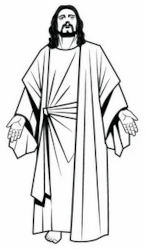 man named Jesus who went everywhere doing good and teaching love.
To my young mind, he seemed like the only one who truly understood me. Soon he became my friend, and somehow that friendship began to soothe my poor, troubled soul.
Eventually, I worked up the courage to walk to the front of the church during the benediction, joining the line of people who were going forward.
When my turn finally came, the preacher leaned over and whispered something quietly into my ear. At the time, I believed that whatever he said was what had “saved” me from the terrifying fate of the bottomless pit that haunted my dreams.
Later came baptism, and sometime afterward the nightmares gradually began to fade away.
Church
At one point during my early teenage years, my dad took me to a church I attended somewhat reluctantly. During the service, a man who had apparently been a member there for quite some time 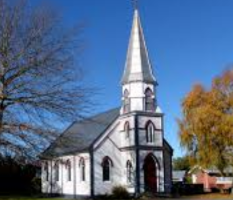 stood up to give his “testimony.”
But instead of feeling inspiring or spiritual to me, it sounded more like a public display of religious self-congratulation — especially as he spoke proudly about how faithfully he paid his tithes and fulfilled his religious duties.
Something about it deeply disturbed me. Even as a teenager, it felt hollow and profoundly wrong inside my spirit. I remember becoming so uncomfortable that I finally walked out of the church building altogether, with my father following behind me demanding that I come back inside.
But by that point, something in me had already broken away.
I told him, “No way am I ever going back to church anymore.”
He threatened me with a severe whipping, but after that day I rarely returned to church for many years — at least not until I was around nineteen years old.
This was the difficult beginning of my religious experience. Throughout most of my teenage years, I developed a strong dislike for church and usually tried to avoid going whenever I could. By the time I was too old for spankings, church attendance had more or less faded out of my life altogether.
There was, however, one notable exception.
After meeting a girl at summer camp, I began attending the church she went to. My motivations at the time were probably far more romantic than spiritual.
That was where I experienced my first kiss — beneath a bright full moon.
It may not have been much of a religious experience, but it remains one of the most beautiful memories of my youth.
The Unpardonable Sin
To make a long story short, my parents divorced when I was around fifteen years old. A few years later, at about nineteen, I went to live with my father. By that time I had hardly attended church for years, but my dad strongly believed that going to church was important and insisted that I start attending again.
Perhaps realizing how negative my earlier experiences in Baptist churches had been, he suggested trying a non-denominational church instead — though it turned out to be strongly Pentecostal in style.
For someone who had grown up in quiet Baptist churches where hardly anyone made a sound, walking into a service where people were speaking in tongues, shouting, and expressing themselves very emotionally was quite a shock to me.
Blasphemy?
At one point during a service, I heard a woman speaking in what the church believed was prophecy. To me, having never experienced anything like that before, it sounded strange and unsettling.
I quietly remarked to someone nearby that, to me, it almost sounded as though the Devil were speaking through her.
But according to them, this was the “Holy Ghost” speaking.
That realization terrified me.
I immediately began wondering whether I had committed the unforgivable sin — “speaking against the Holy Ghost.” At the time, it truly felt possible, and the fear of it stayed with me for many years afterward.
It became one of those thoughts that quietly tormented my conscience and weighed heavily on my soul for a very long time.
At around nineteen years old, living with my dad was no longer free, so I had to find work. While working at an oil refinery, I met a man with a Pentecostal background, and since we had both attended similar churches, we often talked about religion.
At one point, he became very enthusiastic about showing me, through various Bible verses, that a Christian could “blaspheme the Holy Ghost” and lose their salvation.
Given the fears I was already struggling with internally, those discussions had a profound effect on me.
Remembering the comment I had once made about the woman prophesying caused me to believe that I may have committed the so-called “unpardonable sin” and lost my salvation forever.
At that point in my life, I had very little real understanding of spiritual matters and only limited knowledge of the Bible itself. But fears rooted in confusion, ignorance, and frightening religious concepts took hold of my mind so strongly that they eventually led to severe anxiety and even panic attacks.
The fear of having lost my salvation tormented me relentlessly. Over time, the anxiety became so intense that it developed into severe panic attacks.
There were moments when the emotional pain became so overwhelming that I would scratch my skin until it bled. Strangely, the physical pain sometimes felt easier to bear than the anguish I was experiencing internally, and for brief moments it even seemed to distract me from what was happening inside my mind.
These anxiety and panic attacks continued for several years. I tried almost everything I could think of to keep my mind occupied and escape the constant fear.
At one point, I even went to the pastor of my church seeking reassurance and answers. But his response was uncertain — he said he “wasn’t sure, but didn’t think so.”
To someone trapped in that level of fear, uncertainty was no comfort at all.
It was difficult enough for me to even talk about these fears, much less seek real help for them, so the inner torment simply continued year after year.
Even the thought of death became terrifying to me because, in my mind, as long as I was still alive there was at least hope — but after death there could be only eternal punishment in the fires of Hell.
What exactly was the “unforgivable sin” or the “blasphemy against the Holy Ghost”? Could a person truly commit it? Had I already done so without realizing it? If I had somehow lost my salvation, could it ever be restored again?
At the time, I had no real certainty about any of these questions. Reading the passages in the Bible only seemed to deepen the fear, because to me they sounded absolute — permanent — forever.
However, because the meaning of this “blasphemy” is far from clear, many people interpret it as rejecting God or refusing His offer of salvation.
Yet even that explanation never seemed entirely convincing to me.
After all, the word blasphemy sounds like something spoken directly against the Holy Ghost itself, doesn’t it?
“Wherefore I say unto you, All manner of sin and blasphemy shall be forgiven unto men: but the blasphemy against the Holy Ghost shall not be forgiven unto men (ever!).”
“And whosoever speaketh a word against the Son of man, it shall be forgiven him: but whosoever speaketh against the Holy Ghost, it shall not be forgiven him, neither in this world, neither in the world to come” (Matthew 12:31–32, KJV)
To me at the time, it sounded unmistakably clear: the sin was speaking against the Holy Ghost.
That made it nearly impossible for me to simply explain the fear away or escape the constant torment these thoughts created in my mind. The idea of eternal punishment — suffering forever in the flames of Hell, with no possibility of forgiveness in either this life or the next — filled me with overwhelming dread.
And these were not presented as merely the words of men, but as the words of Jesus himself — God in the flesh.
To my frightened mind, it felt final.
What a terrible burden for a human being to carry.
And the Bible is the “inerrant” truth… Or is it?
At the time, it seemed to me that the only possible escape from this terrifying destiny would be if Jesus had never actually said those words at all.
But how could anyone truly know?
There are no original manuscripts, the Gospels were written long after the events they describe, and even the identities of the four Gospel writers are not completely certain. Yet despite all of that, I still viewed every single word in the Bible as the literal and inerrant words of Jesus himself.
Eventually, after years of studying not only the Bible but also history, theology, and many other sources outside traditional religious teachings, I gradually began to question whether some of these fear-based ideas truly originated with Jesus himself.
It became increasingly apparent to me that throughout history, religious fear has often been used as a powerful instrument of control — shaping consciences, influencing behavior, and keeping people spiritually dependent upon religious authority.
That realization affected me deeply.
I began wondering how many countless people, throughout history and even today, may have lived with the same inner torment, fear, guilt, and spiritual anxiety that I had experienced for so many years.
Yet at the same time, I also began to sense that beneath centuries of doctrine, fear, and institutional influence, there were still authentic teachings of Jesus shining through clearly — teachings centered on compassion, truth, love, inner transformation, and the deeper spiritual nature of man.
One thing I gradually came to believe was that there were words Jesus truly said, such as:
“And ye shall know the truth, and the truth shall make you free.” (John 8:32)
Thanks to certain words attributed to Jesus in the Bible — words that deep inside I personally believe may truly reflect his spirit and message — I was finally able to begin breaking free from the chains of fear and deception that had kept me living in spiritual torment for so many years.
I cannot honestly prove which words Jesus actually spoke and which he may not have spoken. No one truly can. But there were certain teachings attributed to him that resonated deeply within me in a way completely different from the fear-driven doctrines that had haunted my mind for years.
It felt as though the entire bubble I had been living inside suddenly burst.
Gradually, I began to suspect that some of the terrifying ideas that had kept me emotionally imprisoned may never have originated with Jesus at all, but were later religious constructions used to place fear into the hearts of people and maintain spiritual control over them.
Knowing and Believing
Knowing and believing are two completely different things.
Belief is accepting an idea because we heard it, were taught it, or read it somewhere — even though we may have no real way of knowing with certainty whether it is actually true.
That realization eventually became deeply important to me.
Why continue holding onto ideas that cannot truly be known, especially when those ideas produce fear, torment, guilt, and emotional suffering rather than peace or understanding?
Perhaps this is one reason so many people have gradually turned away from religion altogether. Religion is supposed to help people, bring peace, and provide spiritual guidance — yet for many it has instead become a source of fear, confusion, and inner conflict.
Believe it or not, one of the things that ultimately helped me most was learning to stop automatically believing everything I was told.
I had accepted many ideas and doctrines without ever really knowing whether they were actually true or not. I simply believed them because I had heard them repeatedly from others, read them in religious materials, or assumed they must be true because trusted authority figures said so.
Eventually I began asking myself: why continue believing things when there is no clear way to truly know whether they are real Truth or not?
Over time, I discovered that many things I had unquestioningly accepted were simply not true at all.
So in a sense, I threw everything out — the baby, the bathwater, and everything else along with it — and started my search all over again from the beginning.
That was the condition I found myself in: believing almost everything I heard without ever seriously examining it for myself. I had never really learned how to research deeply, question honestly, or think critically and independently about what I believed.
In many ways, I had become a prisoner inside my own mind because I depended so heavily on others to do my thinking for me.